Why neck and shoulder pain persists after a crash
When the neck or upper back is suddenly forced forward and back, as in a rear-end or side-impact collision, muscles such as the trapezius, levator scapulae, and deep neck stabilizers contract abruptly to protect the spine. Even after tissue healing, these muscles may remain overactive and irritable, leading to chronic pain or tingling that radiates into the head, shoulder, or upper back.
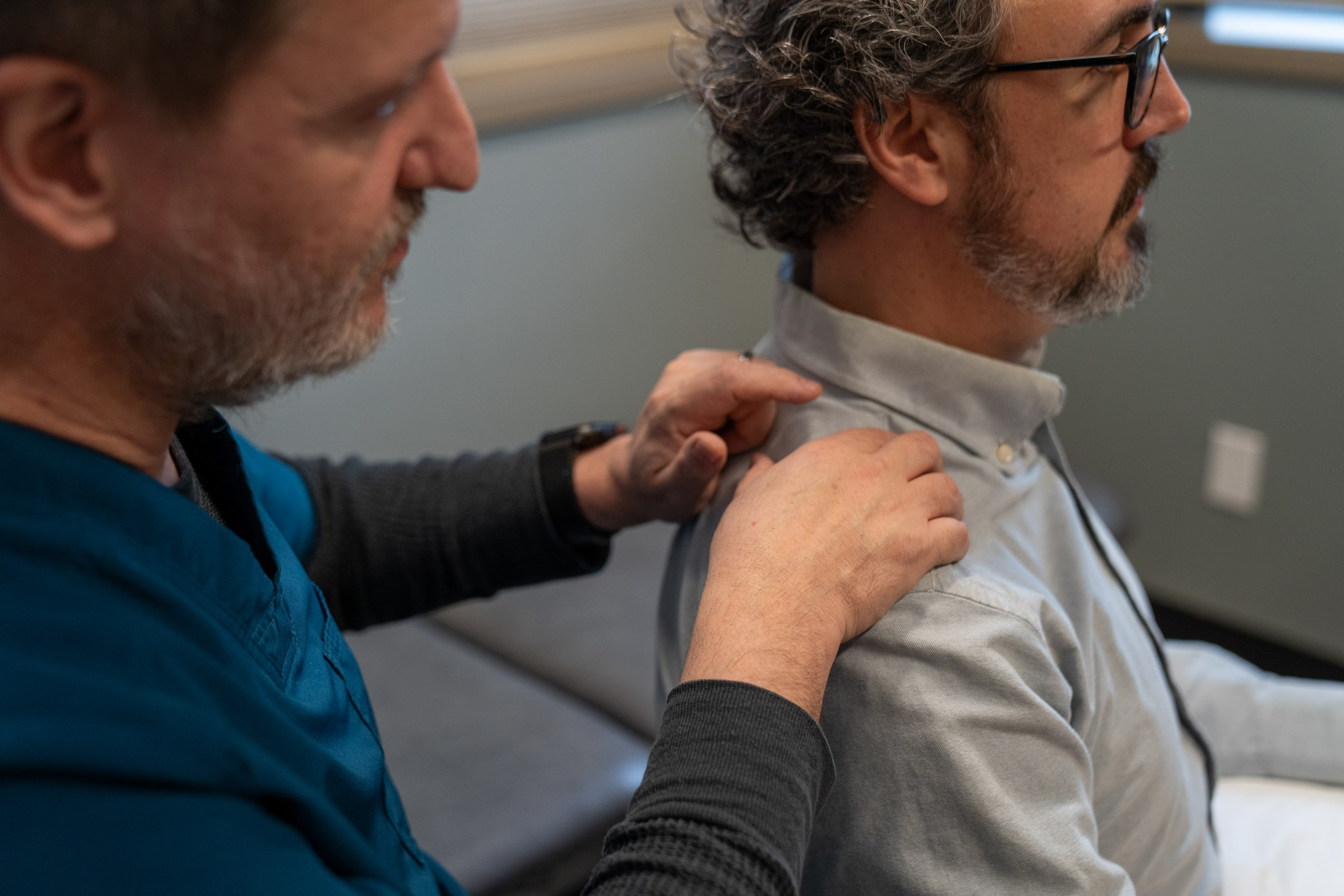
- Protective spasm immediately after impact
- Trigger points form with micro-trauma and guarding
- Referred pain can mimic nerve compression
- Persistent tension alters joint mechanics and fuels a pain cycle
Four techniques compared
| Technique | Mechanism | Clinical considerations |
|---|---|---|
| Hydrostatic intramuscular stimulation (hydrostatic IMS) | Combines mechanical twitch stimulation with gentle hydrostatic expansion from a small saline injection. | Equal or greater relief than lidocaine with fewer side effects. Saline does not sting, minimal allergy risk, preserves feedback for deeper release. |
| Dry needling / IMS | A solid filament needle is inserted into taut muscle bands to elicit a twitch response and mechanically reset abnormal tone. | Effective short to medium term; usually needs multiple sessions; mild post-needling soreness is common. |
| Trigger point injection (lidocaine) | A hollow needle delivers a small amount of local anesthetic into the trigger point for chemical pain blockade and relaxation. | Lidocaine can sting; rare allergic or preservative reactions. May numb feedback and briefly obscure retraining signals. |
| Acupuncture (traditional East Asian) | Fine needles modulate pain and autonomic tone; different from trigger point or injection methods. | Helpful for calming, sleep, and stress. Not ideal for releasing deep trigger points: it doesn't mechanically disrupt taut bands. Best as a complement to rehab or IMS. |
Why hydrostatic IMS fits whiplash recovery
- It addresses both neuromuscular dysfunction (needle stimulation) and localized tissue pressure (saline expansion).
- It enhances circulation and proprioceptive retraining without numbing, and targets muscle-driven pain that outlasts ligament or joint healing.
- It often achieves relief in fewer sessions than traditional IMS or trigger point injection.
Timing matters. Hydrostatic IMS can help after about six weeks, and it is often most useful in the six-to-twelve-month window.
Evidence summary
- Wet needling (saline or lidocaine) often outperforms dry needling alone for short- to medium-term relief.
- Hydrostatic IMS shows improvements in pain, motion, and mood versus lidocaine injection in randomized trials.
- Outcome depends more on accurate intramuscular targeting than on the choice of injectate.
- Best results come when it is paired with postural and activation retraining.