In clinic I frequently meet patients, often between 25 and 65, with spine pain that is worse after sitting or bending and somewhat better with standing or walking. They may describe "numbness" into the thighs or arms that, on closer questioning, is burning or tingling rather than true loss of sensation. Then the MRI report arrives, and words like "bulging" and "degenerating" sound frightening. Patients imagine bones or discs pinching nerves. That's usually not the story.
The disc over a lifetime
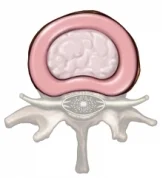
Young
A soft, mobile center (nucleus pulposus) held by flexible annular rings. As we bend and twist, it presses gently on its padded walls, one reason younger backs bounce back faster.
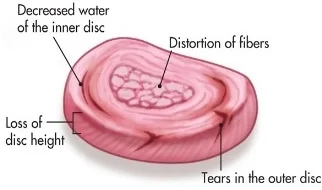
Middle years (25–65)
The nucleus works on the annular walls, creating bulging and small tears (fissures). This isn't always painful. When nuclear material settles toward the back of the disc, the body may splint with muscle spasm.
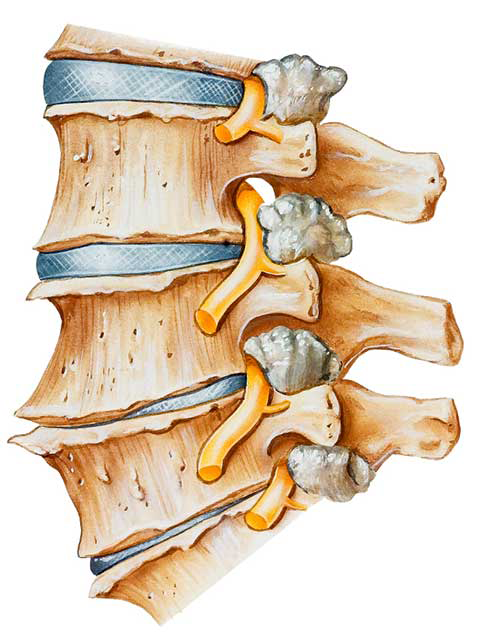
Later (often 65+)
The nucleus dries and stiffens and the disc flattens. It is often less painful, though the levels above and below may take on more motion and sometimes become the new trouble spot.
Why sitting hurts more: sitting lets the nucleus drift backward into the sensitive annular wall. Standing up or extending helps it re-center.
Bulge or herniation
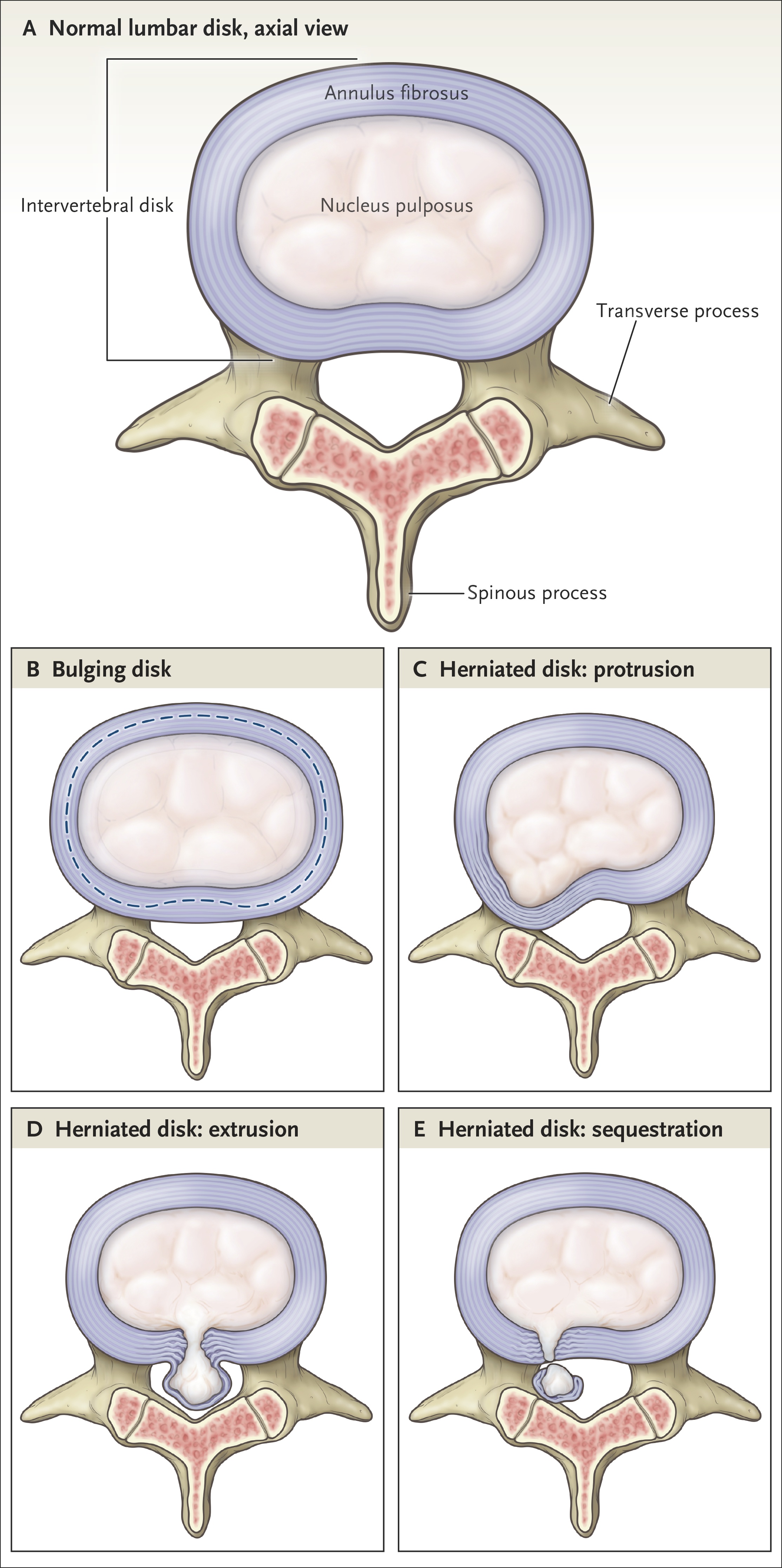
A disc bulge is a diffuse, symmetric extension of the disc's outer wall, like a tire going flat. It does not meet the definition of a herniation and is common in people with no pain at all, as a normal part of aging [1][2].
A herniated disc is a focal displacement of disc material beyond the normal disc space. Only protrusion, extrusion, and sequestration count. In an extrusion the material extends beyond the disc space, narrower at the neck; in a sequestration a fragment breaks off and floats free in the canal.
Not a pinched nerve
This common "degenerative disc" pain is not the same as a pinched nerve (radiculopathy). It can hurt, sometimes a lot, but it isn't generally dangerous.
Rare in collisions
Most herniated discs come from gradual degenerative change and repetitive loading, not from a single impact. Disc injuries are extremely rare in car crashes, about 0.01 occupants per 10,000 exposed, and typically occur alongside other significant trauma or unusual loading such as high flexion and compression. Sprains and strains are far more common [3].
Pinched nerve or not
Radiculopathy means objective neurologic deficits: muscle weakness, loss of reflexes, or sensory loss in a specific dermatome. Radicular pain (sciatica) is simply the sensation of pain traveling down the nerve path.
A true radiculopathy follows a specific stripe of skin, the dermatome supplied by that nerve. If the sensory change doesn't follow that map, the pain is likely not from the disc. This is why I use sensory mapping: careful bedside testing can often detect nerve root irritation an MRI might miss, or confirm that a bulge seen on the MRI really is the source [4][5][6].
Do injections fix it?
Epidural steroid injections (ESIs) help mainly radicular pain from nerve root irritation, and most in true radiculopathy. That irritation is often chemical, inflammation from the disc material rather than compression alone, which is why steroids can calm the nerve even if the disc doesn't move [8][12][13].
Modest and short-term
Meta-analyses show a small reduction in pain scores at three months, but the number needed to treat for relief is high (7) [7].
No long-term fix
In the SPORT trial, outcomes at four years were no different between patients who had ESIs and those who did not [14].
Pain alone
Little to no benefit for back pain, or for leg pain without objective neurologic findings [7]–[11].
What helps
- Reassurance. Knowing these MRI findings are universal after age 30 reduces fear.
- Movement. Extension-based exercise or physical therapy eases pain by restoring balance, and most people improve over time without intervention [1][2].
- Medication and rest. Anti-inflammatories and brief rest, for acute flares only.
- Surgery. Microdiscectomy is reserved for severe or progressive neurologic deficits, or symptoms that don't respond to non-surgical care. It relieves sciatica faster, but long-term outcomes are similar to conservative treatment [2].
Bottom line: "Degenerative disc disease" is mostly a reflection of time, not necessarily damage. True herniations rarely come from crashes, injections offer limited short-term help, and conservative care remains the mainstay. Understanding the MRI and moving with confidence is often the best treatment.
Evidence (14 sources)
- Deyo RA, Mirza SK. Herniated Lumbar Intervertebral Disk. NEJM. 2016.
- Zhang AS, et al. Lumbar Disc Herniation: Diagnosis and Management. American Journal of Medicine. 2023.
- Kent R, Cormier J, McMurry TL, et al. Spinal Injury Rates and Specific Causation in Motor Vehicle Collisions. Accident Analysis & Prevention. 2023;186:107047.
- Hasvik E, et al. Pinprick and Light Touch Are Adequate... Clinical Orthopaedics. 2021.
- Erbüyün SC, et al. Lumbar Disc Herniation... Sensory Test. Pain Medicine. 2018.
- Samuelsson L, et al. Thermal Quantitative Sensory Testing... European Spine Journal. 2002.
- Armon C, et al. Epidural Steroids for Cervical and Lumbar Radicular Pain... AAN Guidelines. Neurology. 2025.
- Knezevic NN, et al. Low Back Pain. Lancet. 2021.
- Oliveira CB, et al. Epidural Corticosteroid Injections for Lumbosacral Radicular Pain. Cochrane Database. 2020.
- Chou R, et al. Epidural Corticosteroid Injections... Systematic Review. Annals of Internal Medicine. 2015.
- Epidural Corticosteroid Injections. AAFP (2021).
- Byun WM, et al. Value of 3D MR Lumbosacral Radiculography... AJNR. 2012.
- Takahashi N, et al. Pathomechanisms of Nerve Root Injury... Spine. 2003.
- Radcliff K, Hilibrand A, Lurie JD, et al. The Impact of Epidural Steroid Injections on the Outcomes of Patients Treated for Lumbar Disc Herniation: A Subgroup Analysis of the SPORT Trial. J Bone Joint Surg Am. 2012;94(15):1353-1358.